Schools & CampusesIndoor Air Quality
Classroom CO₂ Monitoring: How School Districts Can Measure Ventilation in Every Room
Brianna Kress - Gostly Team
3 min read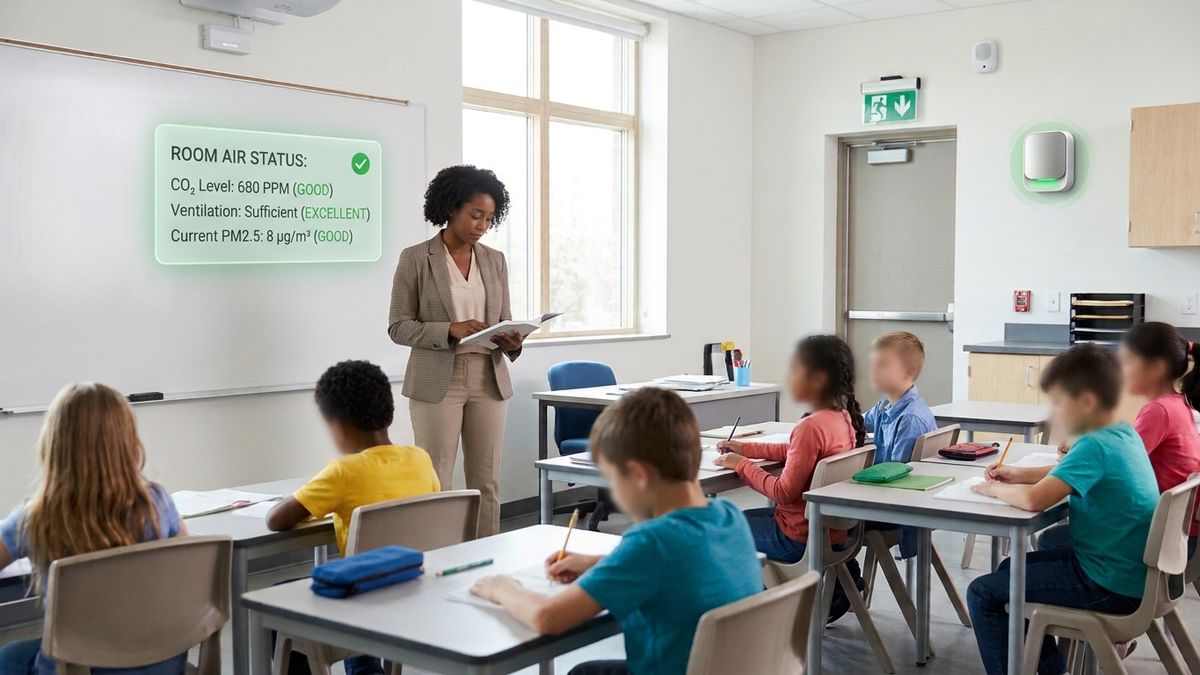
Put thirty students in a closed classroom and the CO₂ level starts climbing within the hour. Nobody notices. The room doesn't smell different, and the thermostat on the wall reads 71°F. But by late-morning that room may be getting far less fresh air than the people in it need.
Districts and campuses are increasingly asked to prove their classrooms are ventilated, by parents, school boards, and state programs (In fact, Virginia now requires schools to manage IAQ this by law). The most practical way to do that is to measure CO₂.
People exhale CO₂, so the level in a room rises with the number of occupants and falls with the amount of outdoor air coming in. That makes it a good stand-in for ventilation. A room that stays close to outdoor influence might keep temperature stable but at the cost of lower air freshness.
CO₂ at classroom levels isn't the hazard itself. What it tells you is whether the air in the room is being replaced. Many guidelines treat a sustained reading around 1,000–1,100 ppm as a sign a room needs more ventilation. The EPA's guidance for schools recommends CO₂ monitoring as an affordable way to check.
The usual approach is a handheld meter and a walk-through: a facilities tech visits a few rooms, writes down a number, and moves on. That misses the problem in three ways.
Continuous monitoring puts a small wireless sensor in each classroom. It reports CO₂, temperature, and humidity every few minutes. Because the sensors run on batteries and talk over LoRaWAN, there's no wiring to run. One gateway typically covers an entire school building.
With every room reporting, the questions change:
The same sensors catch comfort problems too. Rooms that run hot in the afternoon or humid enough to invite mold show up on the same dashboard.
Many districts are adding vape sensors in restrooms and locker rooms, which alert administrators when they trigger without putting cameras in private spaces. most air quality sensors also measure other things beyond CO₂, such as Total Volatile Organic Compounds (TVOC), PM2.5, and PM10, and humidity (low humidity values are unhealthy, while too high can cause issues such as the risk of mold growing).
Continuous data creates a record. When a school board, inspector, or parent asks how a room has been ventilated, you can answer with a chart instead of an anecdote. You can also show what changed after you fixed it.
Most districts pilot one school, prove the data is useful, then roll the same sensor kit out to the rest. See how Gostly works for schools and campuses, or start your free first month.
Written by
Brianna Kress - Gostly Team